

Maybe you have been thinking about scuba diving for months. You have seen the Red Sea from the shore, watched underwater videos, or heard friends talk about their first dive and thought, I would love to try that, but where do I even begin?
For women looking to dive in Jeddah, the good news is that there is no single “right” way to start.
You can begin with a calm shore-entry experience in Obhur, join a women-only boat trip with a female instructor, spend a day snorkeling before deciding whether scuba is for you, or, if you are already certified, head straight into guided shore and boat dives that match your certification level.
Jeddah is especially interesting because the diving is not limited to one type of environment. The coastline gives access to coral reefs, shore dives, boat dives, walls, drift sites, and wrecks, while the Red Sea conditions make diving possible throughout the year.
This guide is designed for both beginners and certified female divers, with extra attention to the questions first-time divers usually have: where to start, what the experience actually feels like, whether you need to swim well, what to wear, how women-only trips work, and how to choose a dive experience that fits your comfort level.
Where Should a Woman Start Diving in Jeddah?
If this is your first scuba experience and you feel slightly nervous about open water, a beginner shore dive in Obhur is often the easiest place to start because you can enter the water gradually and get comfortable with the equipment before going deeper. If privacy and a women-only environment matter more to you, a dedicated boat trip with a female PADI instructor may be a better fit. If you are curious about the Red Sea but not ready for scuba, start with snorkeling. Certified divers can choose guided boat or shore dives based on their certification, experience, and sea conditions.
What Are the Best Diving Options for Women in Jeddah?
The most useful question is not, “What is the most famous dive site in Jeddah?”
It is:
“What type of diving experience makes sense for me right now?”
A first-time diver who has never breathed through a regulator needs something very different from a woman with an Open Water certification and twenty logged dives. Even among beginners, comfort levels vary. One woman may be completely relaxed in deep water, while another may want ten minutes in shallow water just to get used to breathing through the regulator.
That is why it makes more sense to choose the type of experience first and the specific dive site second.
| Experience | Best For | Certification Required? | What to Expect |
| Beginner shore diving in Obhur | First-time divers | No | Gradual entry, briefing, and supervised scuba experience |
| Women-only boat diving | Beginners who value privacy and a female environment | No for beginner programs | Full boat outing with a female instructor |
| Snorkeling | Women not ready for scuba yet | No | Reef viewing from the surface |
| Guided shore diving | Certified divers | Yes | Reef diving based on certification level |
| Certified-diver boat trips | Open Water and above | Yes | Multiple dives and offshore sites |
Jeddah has enough variety that you do not need to force yourself into a more advanced experience just because it looks impressive online. PADI describes the area as offering shore dives, day boats, reefs, walls, drifts, and wreck diving, which means there is room to progress naturally instead of rushing from zero experience into a demanding dive.
For a beginner, comfort and supervision matter more than depth.
For a certified diver, site choice, dive profile, and certification level become much more important.
Why Jeddah Works So Well for a First Scuba Experience
One of Jeddah’s biggest advantages is accessibility.
You do not need to plan an entire diving holiday just to find out whether scuba is something you enjoy. If you live in Jeddah or you are visiting the city, you can go from everyday city life to a genuine Red Sea experience within the same day.
The local diving environment also gives beginners room to progress. There are accessible shore dives, introductory scuba experiences and boat trips, while certified divers can move on to reefs, walls and wrecks.
PADI currently lists diving in Jeddah as possible throughout the year, with typical water temperatures ranging from approximately 21°C to 28°C and visibility that can reach around 20–50 metres depending on conditions. Those numbers are not a guarantee for the day you book; current visibility and the selected site always matter, but they explain why Jeddah has become such a practical base for Red Sea diving.
For beginners, another important advantage is that you do not need to commit to a full certification course before discovering whether you enjoy scuba.
Introductory scuba experiences are designed for that exact situation.
You learn the basic equipment, practice breathing through a regulator, understand essential hand signals, and experience being underwater under direct professional supervision.
What you should not assume, however, is that one introductory dive makes you a certified diver.
It does not.
Think of your first experience as answering one question:
“Do I enjoy scuba enough to learn it properly?”
If the answer is yes, Open Water certification can come next.
Shore Diving in Obhur: A Comfortable First Step
For many first-time divers, shore diving in Obhur is the least intimidating way to enter scuba.
There is a psychological difference between walking gradually into the sea and travelling offshore by boat before making your first underwater descent.
With a shore entry, everything happens at a slower pace.
You put on the equipment.
You listen to the briefing.
You enter the water.
You try breathing through the regulator.
And if that first breath feels strange, you have time to stop, reset, and try again before continuing.
Jeddah Diving Center currently offers a beginner shore-diving experience in Sharm Obhur that does not require previous certification. The published program includes a full safety briefing, equipment preparation, and a supervised dive with a certified instructor.
The real benefit, though, is not simply the location.
It is the pace.
Imagine putting your face underwater and breathing through a regulator for the first time. You know logically that the equipment is supplying air, but your brain has spent your entire life associating “face underwater” with “do not breathe.”
That first adjustment can take thirty seconds for one person and ten minutes for another.
Both are normal.
A shore dive gives you room to get comfortable without feeling as if an entire boat is waiting for you to descend.
And if your friend adapts immediately while you need more time?
Do not compare yourself.
The goal of a first dive is not to be the fastest person into the water or the deepest person in the group.
A successful first dive is the one that makes you surface thinking:
“I want to do that again.”
Women-Only Scuba Diving Trips in Jeddah
For some women, the biggest question is not depth, equipment, or marine life.
It is the environment.
Will the trip be women-only?
Will the instructor be female?
Can I go with my friends?
What are the privacy arrangements on the boat?
Will I feel comfortable getting ready for the dive?
These questions matter, and they should be answered before you book.
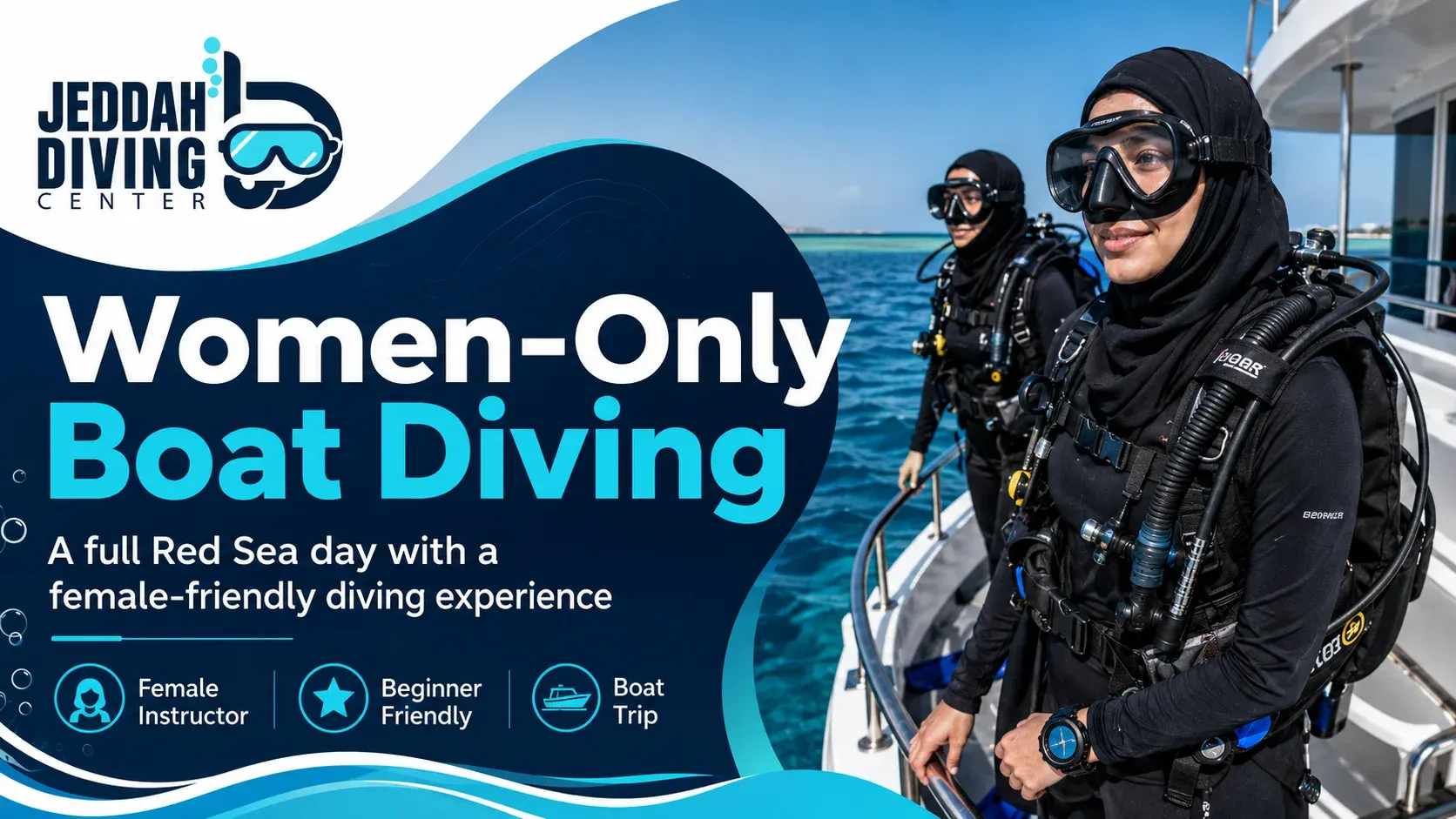
Jeddah Diving Center currently offers a dedicated women-only boat diving experience led by a female PADI instructor. The published beginner program is designed for women without previous diving certification and includes a six-hour boat experience with one supervised scuba dive.
For someone who wants more than a short diving session, the boat format can make the day feel like a complete Red Sea experience.
The day includes the ride offshore, time with the group, pre-dive preparation, the underwater experience itself, and time on the boat afterwards.
That makes it particularly suitable for:
- A first dive with friends
- A girls’ day on the Red Sea
- A mother-and-daughter experience
- A birthday activity
- A woman who wants to try scuba solo but prefers a female environment
Privacy, however, should never distract from the fact that scuba diving is still a technical activity.
Before entering the water, you need to understand how to breathe, equalize your ears, communicate with the instructor, and signal if something does not feel right.
And if you decide at any point that you are not comfortable?
Say so.
There is no prize for being the first person off the boat.
Shore Dive or Boat Dive: Which Is Better for a Beginner?
Neither option is automatically better.
The better experience is the one that fits your personality and comfort level.
Choose a shore dive if you:
- Feel slightly nervous about open water
- Want a gradual entry
- Prefer to become comfortable with the equipment before going deeper
- Want your first scuba experience to feel simple and controlled
Choose a women-only boat trip if you:
- Are already reasonably comfortable in the sea
- Prefer a female-only environment
- Want a full day out rather than a short activity
- Are joining with friends
- Like the idea of reaching an offshore dive site
If you are still unsure about scuba altogether, snorkeling may actually be the better first step.
That does not mean you are “less adventurous.”
It simply means you are giving yourself a chance to understand how you feel in open water before adding a tank, regulator, and buoyancy equipment.
There is no correct order that every woman needs to follow.
Some people snorkel for years before trying scuba.
Others put on a tank once and immediately wonder why they waited so long.
Is Snorkeling a Good Step Before Scuba Diving?
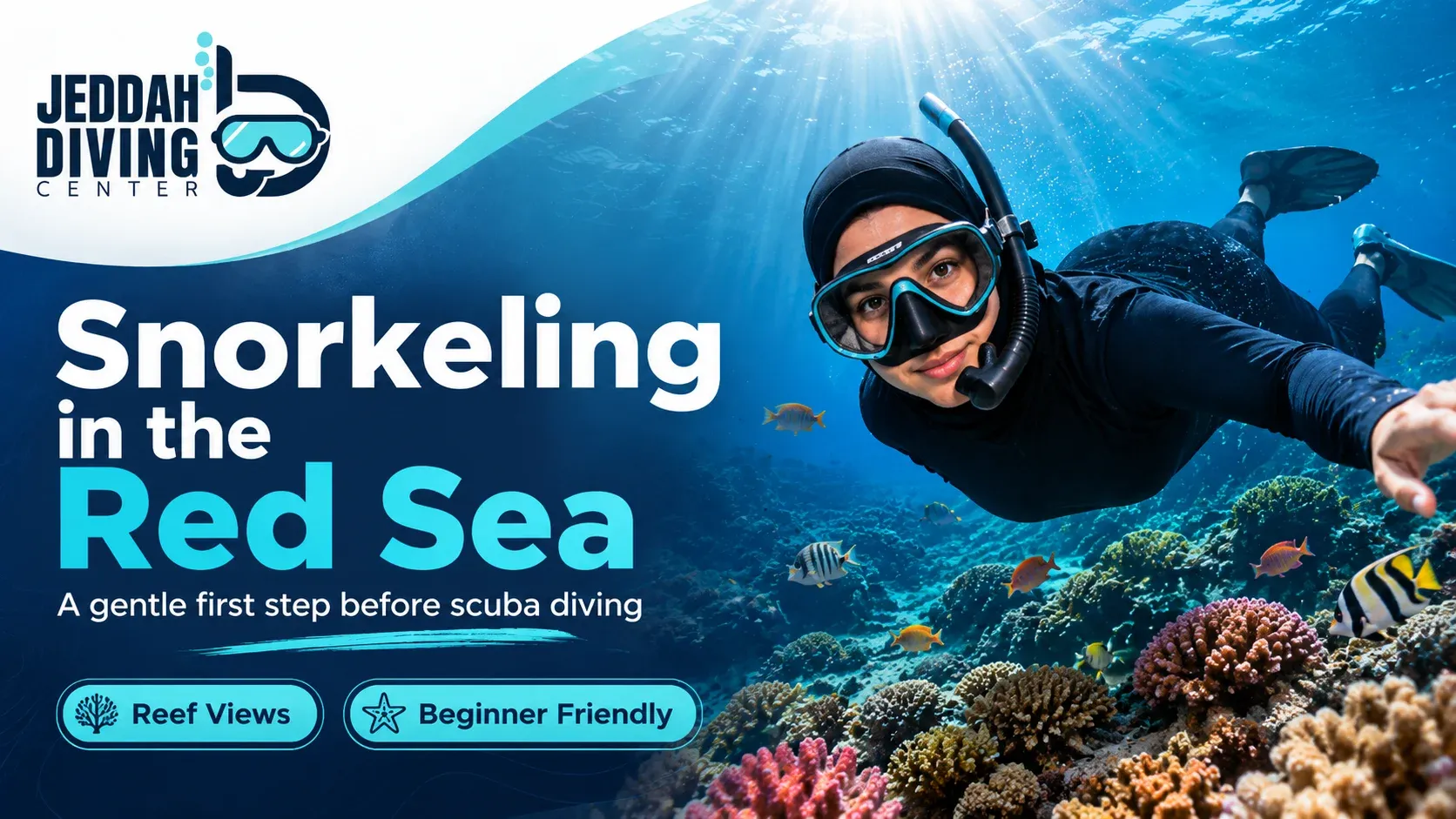
Yes, especially if the ocean interests you more than the equipment does.
Snorkeling cannot recreate scuba diving. You remain at the surface, your breathing is different, and you do not experience neutral buoyancy or the feeling of moving through a reef underwater.
But it gives you something valuable:
Familiarity with the sea.
You become used to wearing a mask.
You learn what fins feel like.
You discover whether open water makes you relaxed or anxious.
You see coral and marine life from the surface.
And most importantly, you can decide whether you want to go further.
This is especially useful for groups where not everyone wants the same activity.
Imagine five friends planning a day at sea. Two desperately want to try scuba. One is curious but nervous. Two would rather swim and snorkel.
A marine outing that allows different comfort levels can make far more sense than pressuring everyone into the same activity.
For some women, snorkeling is enough.
For others, seeing the reef from the surface creates the exact opposite reaction:
“I need to know what it looks like down there.”
That is when scuba starts to make sense.
What About Bayadah Island?
Bayadah is one of the names you will frequently see when researching marine activities around Jeddah.
Its clear turquoise water, coral environments, and offshore setting make it a popular Red Sea destination, and Visit Saudi currently describes Bayadah as one of Jeddah’s notable coastal destinations for nature and marine activities.
But there is an important distinction:
A trip to Bayadah is not automatically a scuba-diving trip.
Many Bayadah excursions focus primarily on:
- Swimming
- Snorkeling
- Boat time
- Reef viewing
- Relaxation
Visit Saudi currently lists Bayadah experiences built specifically around guided snorkeling and swimming, while other tourism programs include scuba as part of broader itineraries.
So never book based on the destination name alone.
Ask exactly what the trip includes:
- Is scuba diving included?
- Is it snorkeling only?
- Can non-certified divers scuba dive on the program?
- Is a female instructor available?
- How many dives are included?
- Is equipment included?
- Is scuba the main activity or an optional extra?
For a beginner who is still uncertain about diving, Bayadah can make a great introduction to Red Sea marine life through snorkeling.
For a woman specifically searching for a women’s scuba-diving experience in Jeddah, however, a clearly defined beginner scuba program is usually a better choice than assuming that every Bayadah trip includes diving.
Abu Tair and Wreck Diving: When Should You Try It?
Once you spend some time around divers in Jeddah, you will eventually hear people talk about Abu Tair and wreck diving.
This is where diving begins to feel less like a first-time activity and more like exploration.
One of the best-known wrecks associated with Abu Tair is the Staphonos, commonly known as the Cable Wreck. Visit Saudi’s Jeddah guide identifies the wreck as a ship that sank in 1978 while carrying cargo including cables, fencing, and steel beams.
Wreck diving has a completely different atmosphere from an easy reef dive.
A sunken vessel gradually becomes part of the marine environment. Fish gather around it, coral life develops, and the structure itself creates a sense of history that open reef diving does not have.
But that is exactly why beginners shouldn’t choose a wreck simply because the photos look dramatic.
A dive site is not defined by its name alone.
Its difficulty can change depending on:
- Depth
- Current
- Visibility
- Sea conditions
- Entry and exit
- Your certification
- Your buoyancy control
- The experience of the group
There is also a major difference between diving around a wreck and penetrating inside a wreck.
Entering an overhead environment is not something a beginner should improvise because a doorway happens to look inviting. Overhead environments remove direct access to the surface and require appropriate training, planning, and procedures.
If you are new to scuba, you are not “missing out” by saving wrecks for later.
Build the skills first.
Learn to control your buoyancy.
Become comfortable monitoring your air.
Get used to following a dive plan.
Then advanced sites become far more enjoyable because your attention is on the wreck, not on trying to remember how your equipment works.
What Actually Happens on Your First Scuba Dive?
Not knowing what will happen is often more frightening than the dive itself.
So here is the part most beginners wish someone had explained beforehand.
1. You Start on Land or on the Boat
Nobody should simply hand you a tank and tell you to jump.
Your instructor introduces the key equipment and explains the parts you actually need to understand for the experience.
You will usually be introduced to:
- Mask
- Fins
- Regulator
- Air cylinder
- Buoyancy control device
- Basic gauges or monitoring equipment
You do not need to memorize an equipment manual.
You simply need to understand what you are using and how your instructor expects you to respond.
2. You Receive a Safety Briefing
You learn basic communication signals and what to do if something feels wrong.
You also learn one of the most important parts of descending underwater:
equalizing your ears.
3. You Try Breathing Underwater
For many beginners, this is the strangest moment of the entire experience.
The regulator works.
You are receiving air.
But your brain may still need a few moments to accept the idea that breathing underwater is now allowed.
Take your time.
Do not try to breathe unusually deeply or quickly just because you are nervous.
Slow, continuous breathing is what you want.
4. You Begin Descending
As you go down, the pressure changes.
Your ears need to equalize.
If you feel discomfort, stop descending and equalize. If necessary, come up slightly and try again. If you cannot equalize, you should not force the descent. DAN advises divers to stop descending when ear discomfort occurs and end the dive safely if equalization cannot be achieved.
5. The Dive Starts Feeling Like a Dive
This is the moment people struggle to describe afterwards.
The noise above the water disappears.
Your breathing becomes the main sound you notice.
The reef opens underneath you.
Fish stop being something you watch through glass and become part of the space you are moving through.
And for many first-time divers, the thought changes from:
“Can I really do this?”
to:
“Why did I wait so long?”
Discover Scuba vs Open Water: What Is the Difference?
This distinction matters.
A beginner scuba experience allows you to try scuba under professional supervision without becoming a certified diver.
An Open Water Diver course teaches you the knowledge and practical skills required to become a certified recreational diver.
Those are not the same thing.
Think of it this way:
A beginner experience answers:
“Do I like scuba?”
Open Water training answers:
“How do I become a diver?”
If you have never tried scuba before and are still unsure, there is no need to rush into certification.
Try the experience first.
If you surface and immediately start asking when you can dive again, then Open Water becomes the obvious next conversation.
Once certified, you can start joining dives specifically designed for certified divers and explore a much wider range of sites.
How to Choose a Diving Center and Female Instructor in Jeddah
For a first-time diver, the quality of the instruction matters more than how impressive the Instagram feed looks.
Before booking, ask questions.
A professional operator should not make you feel awkward for wanting details.
For a beginner, useful questions include:
- Is the experience designed specifically for non-certified divers?
- Is a female instructor available?
- Is the boat entirely women-only?
- How large is the group?
- Is all scuba equipment included?
- Where does the initial training happen?
- Is the entry from shore or boat?
- What happens if I decide I do not want to continue?
- Can the dive location change if sea conditions are unsuitable?
- Is there a medical questionnaire?
- What swimming ability is expected?
Jeddah Diving Center currently offers separate experiences for beginners and certified divers, including shore and boat options, which is important because the correct program should be selected according to the diver’s actual level, not simply the trip that looks most exciting.
If you are already certified, your questions should change.
Ask about:
- Number of dives
- Minimum certification
- Expected site type
- Maximum planned depth
- Equipment rental
- Tank availability
- Dive guide
- Recent diving experience requirements
- Sea conditions
The certified-diver boat trip currently published by Jeddah Diving Center, for example, is structured around two dives and requires at least an Open Water certification, with diving depth determined by certification level.
And remember:
If a dive operator seems irritated because a nervous beginner asks too many questions before paying, that tells you something.
Good instructors expect questions.
What Safety Rules Should Every Beginner Know?
You do not need to study dive physics before trying scuba, but understanding a few basic principles will make the instructor’s briefing much easier to follow.
Never Hold Your Breath Underwater
Breathe continuously and naturally.
Scuba equipment is designed for you to breathe normally underwater, and holding your breath while changing depth can be dangerous.
Equalize Early
Do not wait for your ears to become painful before equalizing.
Equalize early and regularly as you descend.
If you feel pain, stop.
Do not force your ears.
Do Not Dive Beyond Your Training
A beginner experience is not the time to chase depth.
Likewise, being friends with an advanced diver does not extend your certification limits.
Your dive should match your training.
Stay With Your Instructor or Dive Group
Do not swim away because you saw an interesting fish or want a better photo.
Be Honest on the Medical Questionnaire
The medical form is not an exam you are trying to “pass.”
Its purpose is to identify whether something should be discussed with a doctor before diving.
If a question applies to you, answer it honestly.
Do Not Dive With Significant Congestion
Ear equalization becomes much more difficult when you have congestion. DAN advises against diving with a cold or congestion because it can interfere with normal pressure equalization.
These rules should not make scuba sound frightening.
They should do the opposite.
Scuba becomes much less intimidating when you realize that the activity is built around clear procedures rather than improvisation.
Do You Need to Be a Strong Swimmer to Try Scuba?
Not necessarily, but the answer depends on the program.
A beginner introductory experience may have different water-skill requirements from a full certification course.
Jeddah Diving Center’s current beginner shore-diving information states that participants do not need to be strong swimmers, although basic comfort in the water is expected.
That does not mean swimming ability is irrelevant to every type of diving.
Certification courses involve their own water-comfort and swimming requirements.
So if you cannot swim confidently, do not automatically assume scuba is impossible.
But do not hide it either.
Tell the instructor before you book.
The correct question is not:
“Can non-swimmers scuba dive?”
It is:
“Does this specific beginner program accept someone with my level of comfort in the water?”
When Is the Best Time to Dive in Jeddah?
There is no single month that every diver needs to wait for.
PADI currently lists Jeddah as a year-round diving destination, with water temperatures generally around 21°C to 28°C and potentially excellent visibility depending on conditions.
For beginners, however, the calendar matters less than the conditions on the actual day.
Your instructor may consider:
- Wind
- Waves
- Current
- Visibility
- Water conditions
- Dive-site exposure
- Experience of the group
This is why a dive site may change even after you have booked.
That is normal.
If an operator tells you the original site is not suitable that morning and recommends another location, that can be a sign of good decision-making, not poor planning.
Summer also brings another consideration.
You are not underwater for the entire trip.
On a boat or shore-based activity, you may spend significant time exposed to the sun before and after the dive, so hydration and sun protection matter just as much as the water temperature.
What Should Women Wear for Scuba Diving in Jeddah?
This question comes up constantly before first dives, and the answer is simpler than most women expect.
You do not need a complicated diving wardrobe.
Wear swimwear that feels comfortable under a wetsuit.
If you prefer more coverage, a long-sleeved swimming outfit or suitable rash guard can work well as long as it fits comfortably beneath the diving equipment and does not interfere with movement.
If you have long hair, tie it securely before putting on the mask. Loose hair trapped under the mask seal can allow water to leak in and become annoying during the dive.
For a boat or shore trip, a practical bag might include:
- Swimwear
- Towel
- Dry clothes for afterwards
- Sunscreen
- Hat
- Sunglasses
- Drinking water
- Personal items
- Certification card if you are already certified
- ID if requested by the operator
If privacy or changing facilities are particularly important to you, ask before you book rather than assuming.
A trip being advertised as “women-only” tells you who the participants are.
It does not automatically answer every question about facilities, changing arrangements, or the boat layout.
Jeddah Diving Center’s current women-only trip states that the boat, group, and instructor are female-only, so women booking specifically for that environment can confirm those details before departure.
What If You Are Nervous About Your First Dive?
Being excited and nervous at the same time is probably the most normal reaction possible.
You may be thinking:
What if I cannot breathe properly?
What if water gets inside my mask?
What if my ears hurt?
What if I suddenly want to come back up?
The worst response to those questions is someone saying:
“Just relax.”
Because if relaxing were that simple, you would already be relaxed.
What actually helps is understanding that you still have control.
Tell the instructor you are nervous.
Take more time at the surface.
Practice breathing before descending.
Ask the same question twice if you need to.
Stop if your ears do not equalize.
Signal if you are uncomfortable.
A professional instructor would rather spend extra time helping you settle than push you into a dive you are not ready for.
And if you decide to stop?
That is not failure.
Your first dive is not a test of bravery.
It is simply your first conversation with the underwater world.
You are allowed to take it slowly.
How to Protect Jeddah’s Coral Reefs While You Dive
The first time you see a Red Sea reef underwater, it is easy to forget everything else for a few seconds.
There is movement everywhere.
Small reef fish.
Coral structures.
Light coming through the water.
Colours that look completely different from the surface.
And that is exactly when one rule matters most:
Look – do not touch.
Do not hold coral to steady yourself.
Do not chase turtles or fish for photos.
Do not collect coral, shells, or marine life as souvenirs.
As your diving skills improve, good buoyancy control allows you to move above reefs without kicking or touching them.
A diver who protects the reef is not missing the experience.
She is respecting the reason the experience exists in the first place.
The Red Sea is not simply a background for underwater photos.
Coral systems take years to grow.
The best dive is one where you come back to the surface with memories and photos and leave nothing behind underwater.
What Happens After Your First Dive?
There are two completely valid outcomes.
You may come back to shore and think:
“That was amazing. I am glad I tried it.”
And leave it there.
Or you may surface and immediately ask:
“How deep were we?”
“When can I go again?”
“What certification do I need?”
“What other sites are there?”
That second reaction is usually how a hobby begins.
If you want to keep diving, Open Water Diver certification is the natural next step.
Once certified, your choices expand dramatically.
Jeddah Diving Center currently operates dedicated boat diving for certified divers with two dives per trip and a minimum Open Water requirement. The published program adjusts depth according to certification level.
From there, you can start discovering what kind of diver you actually are.
Maybe you love relaxed reef diving.
Maybe you want boat dives.
Maybe wrecks fascinate you.
Maybe underwater photography becomes your obsession.
Maybe you simply love spending a quiet hour beneath the surface.
Do not rush to collect certification cards.
Comfort, buoyancy, air awareness, judgment, and real diving experience matter far more than how quickly you move to the next course.
How to Book the Right Women’s Diving Experience in Jeddah
After all the information in this guide, the actual decision is surprisingly simple.
Ask yourself:
“What do I want my first experience to feel like?”
If You Want the Easiest Introduction
Start with a beginner shore dive in Obhur.
You enter gradually, receive a full briefing, and experience scuba without needing to begin your day on a boat.
Jeddah Diving Center currently offers this format from Sharm Obhur for beginners without previous certification.
If You Want Privacy and a Women-Only Day at Sea
Choose a women-only boat diving trip.
Jeddah Diving Center’s current women’s program is led by a female PADI instructor and designed for women with no previous scuba certification.
If You Are Not Ready for Scuba Yet
Start with snorkeling.
You can enjoy the Red Sea, become comfortable in open water, and decide later whether scuba interests you.
If You Are Already Certified
Do not book a beginner experience simply because it is marketed to women.
Choose a certified-diver trip that matches your qualification and recent experience. Jeddah Diving Center currently offers both guided boat diving and options appropriate for certified divers.
And whatever you choose, do not compare only by price.
Compare:
- Experience type
- Instructor
- Women-only arrangements
- Equipment included
- Number of dives
- Certification requirements
- Departure point
- Group size
- Trip duration
- Sea-condition policy
If you are still unsure whether shore or boat diving is right for you, contact Jeddah Diving Center and explain that it is your first dive, how comfortable you are in the water, and whether a women-only environment is important.
A good recommendation should start with your comfort level, not with the most expensive trip.
Which Jeddah Diving Experience Fits You?
| Your Situation | Best Starting Point |
| First dive and slightly nervous | Beginner shore dive in Obhur |
| First dive and privacy matters | Women-only boat dive |
| Curious about the Red Sea but not ready for scuba | Snorkeling |
| Tried scuba and loved it | Consider Open Water certification |
| Already Open Water certified | Guided certified-diver boat or shore dive |
| Experienced certified diver | Explore reefs, walls and suitable wreck sites |
You do not need to begin with Jeddah’s deepest or most famous dive site.
You do not need to prove anything.
And you definitely do not need to keep up with a friend who feels comfortable faster than you do.
Your first dive only needs to do one thing well:
make you feel safe enough to discover whether you want a second one.
Frequently Asked Questions About Women’s Diving in Jeddah
Can women try scuba diving in Jeddah without a certification?
Yes. Beginner scuba experiences are available in Jeddah for women who have never been certified. Jeddah Diving Center currently offers both a beginner shore-diving experience and a women-only boat program that do not require previous scuba certification. An introductory experience does not, however, make you a certified diver. You would need to complete an appropriate course such as Open Water Diver before independently joining trips intended for certified divers.
Are there women-only scuba-diving trips in Jeddah?
Yes. Jeddah Diving Center currently offers a dedicated women-only boat trip led by a female PADI instructor. The published program is specifically structured for women and accepts beginners without previous certification.
Is shore diving or boat diving better for a first-time female diver?
Neither is universally better. Shore diving is often easier for someone who wants a gradual entry and extra time to become comfortable with the equipment. A women-only boat trip can be better for someone who is already comfortable around the sea and wants privacy, a female environment, and a full-day Red Sea experience.
Do I need to know how to swim before trying scuba diving?
Requirements depend on the program. Jeddah Diving Center’s current beginner shore-diving experience does not require participants to be strong swimmers, although basic comfort in the water is expected. Certification courses such as Open Water have separate swimming and water-comfort requirements, so always check the specific program before booking.
Is scuba diving in Jeddah suitable for beginners?
Yes, Jeddah offers several environments that can suit new divers, including shore-entry experiences and supervised beginner programs. PADI describes Jeddah as offering diving opportunities for new divers as well as experienced recreational and wreck divers. The correct site on any given day should still be selected according to sea conditions and the diver’s level.
What should I do if my ears hurt while descending?
Stop descending. Try to equalize gently and, if necessary, ascend slightly before trying again. Do not continue downward through pain. If you cannot equalize, the safest choice is to end the descent. DAN specifically advises stopping descent when ear discomfort develops and safely ending the dive when equalization cannot be achieved.
Can I scuba dive if I have a cold or congestion?
Diving with significant congestion is not recommended because blocked Eustachian tubes can prevent proper equalization of pressure in the ears. DAN advises divers not to dive with a cold or congestion. If you have a medical condition or are unsure whether you are fit to dive, follow the medical screening process and seek appropriate professional medical advice rather than relying on another diver’s experience.
No comment